
Termite Liquid Barrier Treatment in Franklin, TN
- Pest Control Service in Franklin
- Quarterly Home Pest Control Plan
- One-Time Interior and Exterior Treatment
- Ant Control
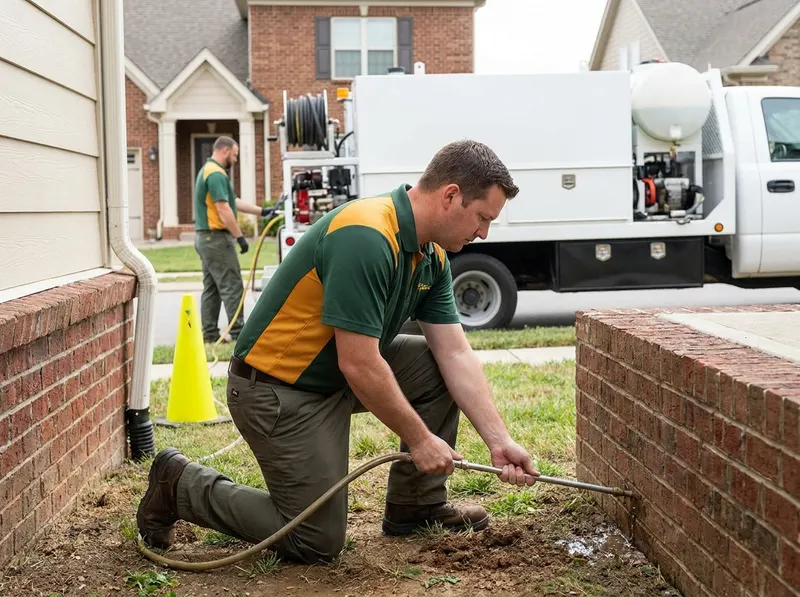
- What's included: full foundation inspection and diagram, entry-point and moisture mapping, soil trenching and rodding at label rate, slab or patio drilling where required, plugged and patched drill holes, and a written record of treated linear footage.
- How fast: most single-family Franklin homes are treated in one visit of roughly 3 to 6 hours; larger crawlspace homes with interior piers can run into a second half-day.
- What it costs: a full perimeter liquid barrier on a typical Franklin home usually falls in the $900–$2,400 ballpark; spot and partial treatments start at our $250 minimum. Exact price is confirmed on the free on-site visit.
- What we treat: soil against foundation walls, under expansion joints, around plumbing penetrations, along interior crawlspace piers and stem walls, and through concrete where the barrier would otherwise be interrupted.
- How to book: call (629) 654-4442 and we schedule a free on-site inspection with a real arrival window — the inspection tells you the linear footage, the drilling needed, and the price before any work starts.
Franklin's soil is the reason liquid barriers work well here. Much of Williamson County sits on heavy clay that holds moisture against footings long after a storm passes, and that damp band of soil is exactly where eastern subterranean termites build their mud tubes. Homes down in the Harpeth River bottomland near Pinkerton Park and the greenway, and lots that drain slowly in Ladd Park and Sullivan Farms, tend to stay wetter at the foundation line than the pictures suggest. Swarmer season runs late March through May — warm afternoon after a rain, and you get winged adults at a sunny window or a pile of shed wings on a Cool Springs office sill. Swarmers indoors mean an active colony has already found a path through the soil, and that path is what a liquid barrier shuts down.
Liquid barrier versus bait stations is the real decision, and it comes down to access. A liquid treatment is the stronger choice when the termites are already inside the structure, when you want a treated zone in place the same day, and when the perimeter can actually be trenched — most slab homes in McKay's Mill, Fieldstone Farms, and Berry Farms fit that description cleanly. In-ground bait systems make more sense when trenching is blocked by hardscape, mature root systems, or a wellhead, or when a homeowner would rather not drill through a stamped concrete patio. The trade-off is honest: <strong>liquid gives you an immediate treated barrier</strong>, while baits work colony-by-colony over months and depend on termites finding the stations. On the older masonry and pier foundations around Hincheyville Historic District, we frequently recommend a liquid barrier plus moisture correction in the crawlspace, because a dry crawl does more for long-term termite pressure than any single application.
Here is the actual visit sequence, so nothing is a surprise. First, a full exterior and crawlspace inspection with a foundation diagram noting active tubes, damaged wood, grade level, downspout discharge, and any soil-to-wood contact. Second, <strong>entry-point and moisture mapping</strong> — mulch beds piled above the brick line, buried siding, AC condensate dumping at the footing, and settled soil at expansion joints all get written down, because those conditions are what invite the next colony. Third, the application: a trench roughly six inches wide against the foundation, rodded where needed, termiticide mixed and applied at the rate the product label specifies, soil replaced, then drilling on a set spacing through concrete with holes plugged and patched. Last, a follow-up window to walk the perimeter and confirm the tubes are dead and no new mud is appearing.
On safety and commitment, two straight answers. The termiticide goes into soil outside your living space or beneath the slab, not on surfaces your kids and dogs touch, and we go over the label's specific re-entry direction with you on site before we mix anything — including where to keep pets while the trench is open. And a liquid barrier is a one-time job, not a subscription: <strong>no annual contract is required to have it done</strong>. If you later want ongoing monitoring or a general pest plan, that's a separate conversation you choose. From Legends Ridge and Simmons Ridge down to Westhaven and the commercial slabs off Cool Springs Galleria, the product is the same — find the entry, seal it, and verify it stayed sealed. Call (629) 654-4442.
Call (629) 654-4442Termite Liquid Barrier Treatment pricing in Franklin
| On-site termite inspection and foundation diagram | Free |
| Spot / partial liquid treatment (single wall, garage, limited crawlspace section) | $250–$600 ballpark |
| Full perimeter liquid barrier, slab home under ~2,000 sq ft | $900–$1,600 ballpark |
| Full perimeter liquid barrier, larger home ~2,500–4,000 sq ft | $1,400–$2,400 ballpark |
| Crawlspace home — perimeter plus interior piers and stem walls | $1,200–$2,200 ballpark |
| Slab / patio / driveway drilling add-on | From $250 ballpark |
| Retreat of a previously treated Franklin home (existing barrier renewal) | $600–$1,200 ballpark |
| Crawlspace moisture correction quoted with treatment (grading, downspout extension, vapor barrier) | Quoted on site |
Exact price confirmed free on-site before any work.
Termite Liquid Barrier Treatment — questions, answered
How much does a termite liquid barrier treatment cost in Franklin, TN?
Most full perimeter liquid barrier jobs on Franklin homes land in the $900–$2,400 range, and small spot treatments start at our $250 minimum. Price is driven by measured linear footage of foundation, how much concrete has to be drilled, and whether a crawlspace needs interior treatment. That's a ballpark — the exact number is confirmed after the free on-site inspection, before any trenching begins.
When is termite swarm season in Franklin and does it change the treatment?
Eastern subterranean termites typically swarm in Franklin from late March through May, most often on a warm afternoon following rain. Swarmers or shed wings inside the house indicate an established colony with a soil route to the structure, which is a strong case for a liquid barrier rather than waiting on bait stations. The application itself is the same year-round; swarm season mostly changes urgency.
Do you have to drill my patio or garage floor for a liquid barrier in Franklin?
Drilling is only done where concrete interrupts the soil barrier — attached patios, garage floors, driveways poured against the foundation, and porch slabs. On many Franklin slab homes in neighborhoods like McKay's Mill and Berry Farms, most of the perimeter can be trenched in soil and only short sections need drilling. Holes are small, spaced on a set interval, then plugged and patched, and we show you exactly where they'll go before we start.
Is liquid termite treatment safe around kids and pets in a Franklin home?
The termiticide is placed into soil outside the living space or beneath the slab, not sprayed on floors, counters, or furniture where a child or dog would contact it. Before mixing, we walk you through the product label's re-entry direction and tell you where to keep pets while the trench is open and the soil is being replaced. Franklin crawlspace applications are done under the house, with the access closed when we finish.