Termite Bait Station Monitoring in Franklin, TN
- Pest Control Service in Franklin
- Quarterly Home Pest Control Plan
- One-Time Interior and Exterior Treatment
- Ant Control
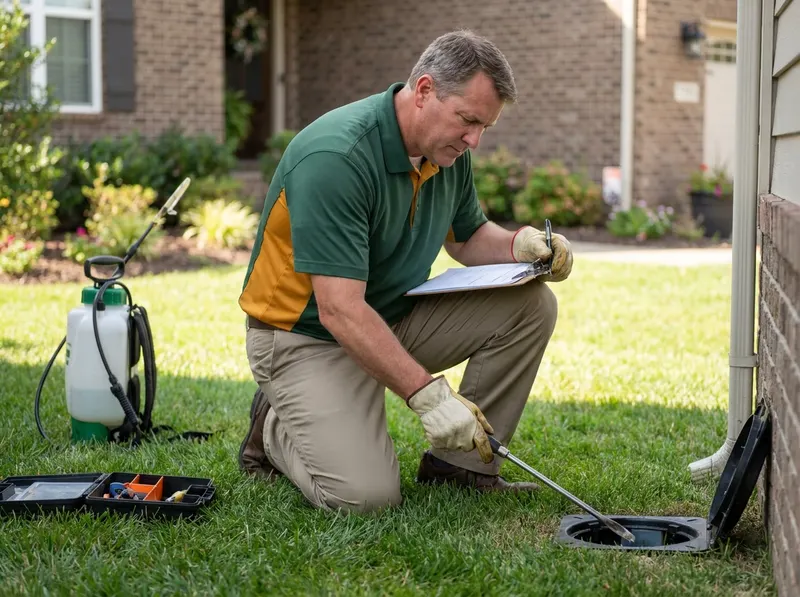
- Included: perimeter station layout and install, a written map of station locations, scheduled re-inspection visits, bait replacement when activity appears, and a moisture and entry-point walkthrough of the foundation, crawlspace access, and mulch beds.
- Speed: most Franklin installs are completed in a single 1-2 hour visit, and monitoring visits typically run 30-45 minutes with no need for anyone to be inside the house.
- Cost: most Franklin bait station programs land between $250 and $700 for the initial install, with annual monitoring commonly $275 to $500; $250 is our minimum service charge and every figure is a ballpark until an on-site look confirms it.
- What we take: card, check, and cash. Pricing is quoted in writing before any station goes in the ground.
- Booking: call (629) 654-4442 for a free on-site inspection in Franklin and Williamson County, and ask for the visit sequence in writing so you know exactly what happens and when.
Bait station monitoring is the right call when trenching and drilling a liquid barrier would tear up something you care about. That covers a lot of Franklin: mature boxwood and hydrangea beds in Hincheyville Historic District, brick walkways and patio hardscape in Westhaven, irrigation lines and French drains ringing newer builds in Ladd Park and Berry Farms, and the stone-and-mortar foundations on older homes near the Franklin Main Street Public Square where owners would rather not see a drill. Stations go into the soil at intervals around the drip line, sit flush with grade, and can be read without anyone entering the house. <strong>Bait works at the colony level rather than the perimeter level</strong>, so the trade-off is timing: a liquid termiticide barrier starts protecting the foundation the day it is applied, while baiting depends on foraging termites finding a station and carrying the active ingredient back, which can take weeks to months. Homes with confirmed active tubes and a straightforward soil perimeter are usually better served by liquid, and plenty of Franklin properties end up with both — stations for early detection out in the yard, liquid where the structure needs immediate coverage.
The local conditions here favor monitoring more than most markets. Williamson County's heavy clay holds moisture against footings long after a storm, and eastern subterranean termites follow that moisture. In neighborhoods on the low side of the Harpeth River drainage — parts of Fieldstone Farms and the streets sloping toward Pinkerton Park and the greenway — we regularly find the wettest soil on the shaded north and east elevations, which is exactly where station hits tend to show up first. Lots backing to treelines near the northern terminus of the Natchez Trace Parkway or the wooded edges around The Park at Harlinsdale Farm bring a second pressure source: stumps, buried construction lumber, and old landscape timbers that feed colonies before the house is ever on the menu. Spring swarms in Middle Tennessee typically run March into May, and a swarmer pile on a windowsill in McKay's Mill or Sullivan Farms is a signal a colony is already mature and nearby, not the start of a problem.
<strong>Our visit sequence is published, not promised.</strong> First visit: full inspection of the foundation, crawlspace or slab edge, downspout discharge, grade, and any wood-to-soil contact, then station placement mapped so the next technician reads the same layout you do. Monitoring visits: each station opened and recorded, bait introduced where there is activity, and the surrounding moisture conditions noted. What follows a hit matters more than the hit itself — we tell you where the pressure is coming from and what to correct, whether that is a splash block, a mulch bed piled above the brick weep holes, or a gutter dumping at the corner. <strong>Entry-point exclusion and moisture correction are the core of the work</strong>, and the bait is the support act.
On the two questions Franklin homeowners ask first: in-ground stations are sealed, installed below grade, and are not a broadcast application across the yard where kids and dogs play, and we will walk your specific setup with you before install. And monitoring is a scheduled service, not a locked contract — you should know the renewal cost, the visit interval, and how to stop, in writing, before you agree to anything. Commercial kitchens and small storefronts in Cool Springs and near The Factory at Franklin can be scheduled outside service hours so nothing happens in front of customers.
Call (629) 654-4442Termite Bait Station Monitoring pricing in Franklin
| Minimum charge, any termite visit in Franklin | $250 |
| Initial bait station install, typical Franklin subdivision home | $250 - $700 |
| Annual monitoring and re-inspection program | $275 - $500 per year |
| Larger or irregular perimeter (over ~250 linear ft, added wings, outbuildings) | $600 - $1,100 install |
| Additional stations for detached garage, deck, or fence line (added to a scheduled visit) | From $250 |
| Station replacement after mower or landscaping damage (added to a scheduled visit) | From $250 |
| Bait monitoring paired with a liquid perimeter treatment | $700 - $1,600+ depending on foundation type and linear footage |
| Takeover of existing stations installed by another company | quoted on-site, $250 minimum |
Exact price confirmed free on-site before any work.
Termite Bait Station Monitoring — questions, answered
How often should termite bait stations be checked on a Franklin home?
Most Franklin bait station programs are read on a quarterly rotation, with tighter follow-up — often 30 to 60 days — once a station shows activity. Stations that go unopened for a year are decorations; the inspection interval is what makes the system work.
Do bait stations work as well as liquid termite treatment in Franklin's clay soil?
Bait stations and liquid termiticide solve different problems on Franklin properties. Liquid creates a treated zone at the foundation immediately, which suits homes with confirmed active mud tubes, while baiting targets the colony over weeks to months and is easier to install around hardscape, irrigation, and mature landscaping. Williamson County clay holds foundation moisture well, which is part of why many homes here benefit from monitoring even after a liquid application.
Can bait stations be installed around older homes near Franklin's Main Street and Hincheyville Historic District?
Yes — in-ground stations are one of the least invasive options for older Franklin homes, since they require no drilling through stone foundations, brick walkways, or original porch work. Placement is planned around root systems and existing plantings, and station locations are mapped so future visits do not disturb established beds.
Will termite monitoring in Franklin lock me into a long contract?
No. Termite bait station monitoring in Franklin is sold as a scheduled service with the visit interval, renewal price, and cancellation terms stated in writing before the first station is installed. If you would rather see the cost structure before committing, ask for it on the free on-site inspection at (629) 654-4442.
I found termite swarmers on a windowsill in Fieldstone Farms — is monitoring enough?
Swarmers inside a Franklin home mean a mature colony is already nearby, so that situation calls for a full inspection first, not monitoring alone. We inspect the crawlspace or slab edge, sill plate, and surrounding soil, and if there is active infestation at the structure we will say so and recommend treatment alongside stations rather than baiting by itself. Middle Tennessee swarm season generally runs March through May.